
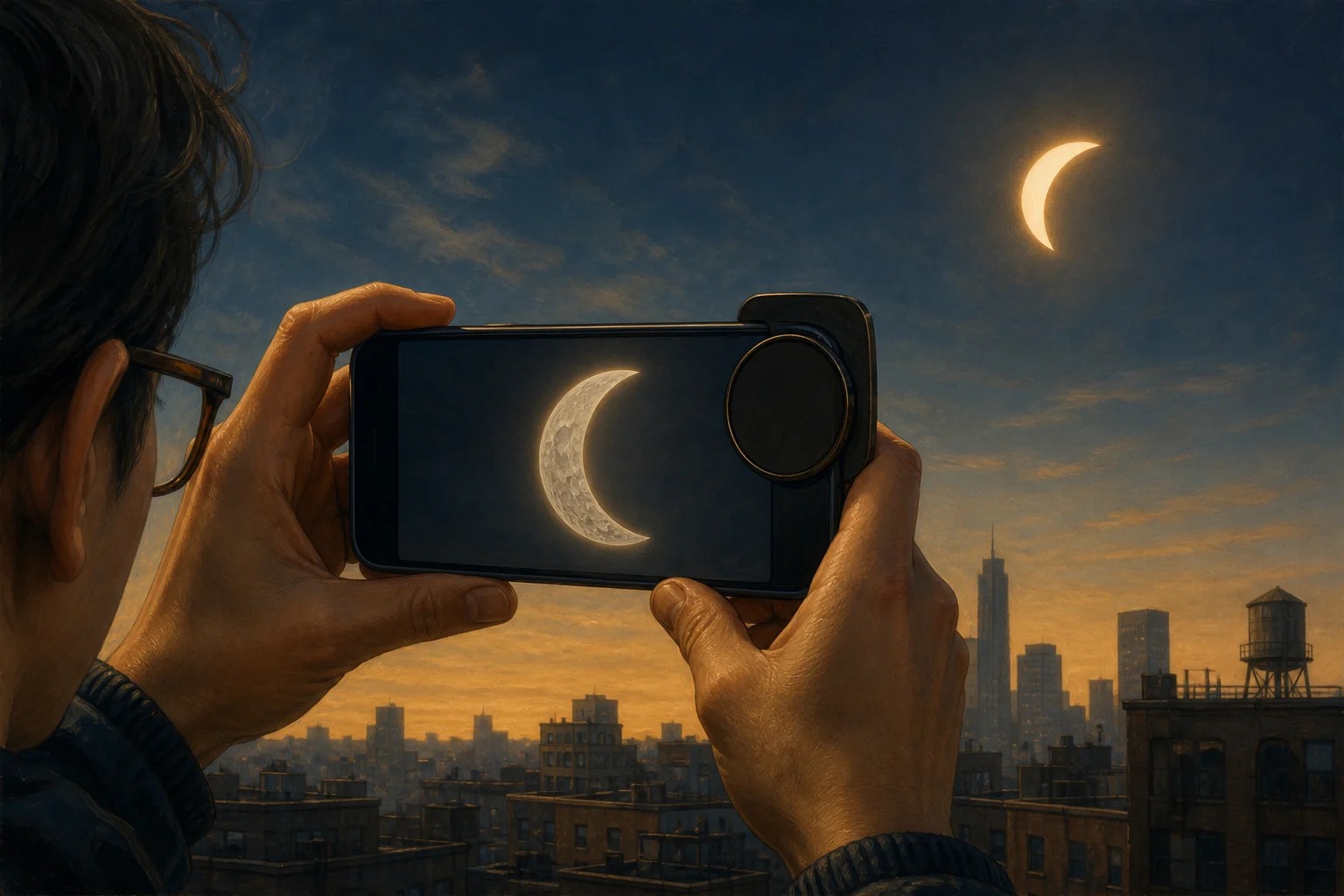
The red-orange disc in Frandroid's solar-eclipse photograph looks as if it has craters. That is the problem: it is the Sun.
During the August 12 eclipse, the French technology publication says a Xiaomi 17 Ultra produced an image in which lunar-looking relief crossed the partly obscured solar disc. Frandroid says it shot the image itself, and that not every frame from the phone showed the effect. Separately, Xiaomi owners posted similar eclipse results from the 15 Ultra and 17 Ultra, sometimes alongside ordinary-mode comparisons.
Those user posts are observations, not controlled laboratory tests. They do not reveal the phone's code, training data or image-processing pipeline. The reports are consistent with moon-oriented scene recognition or processing being applied to an eclipsed Sun, but they do not establish which mode triggered, which processing stage produced the detail, or whether Frandroid's phone entered Supermoon automatically.
That does not establish that Xiaomi pastes a stored Moon photograph over every moon shot. It does not tell us whether the reported result came from a texture overlay, a generative reconstruction, a deterministic enhancement pipeline, or some combination. By publication time, HashSparks found no sufficiently detailed incident explanation in the public Xiaomi channels and web results it checked that would let outsiders make that distinction.
The episode is less a gotcha than a useful look inside the modern smartphone camera. The photograph on your screen is no longer simply what passed through the lens. It is also what the software decided the scene was.
What the reports actually show
Frandroid compared the eclipse through four smartphones. In one Xiaomi 17 Ultra frame, the visible solar disc carried ridges, pits and tonal structure resembling the Moon's surface. The publication says other frames from the same phone did not make the same mistake. It also pointed to two people on X who posted broadly similar results.
On Reddit, one Xiaomi 15 Ultra owner in London said they deliberately selected Supermoon mode and used a solar filter. Another poster using a Xiaomi 17 Ultra reported a crater-like result after manually selecting Supermoon mode and shared a separate image they described as taken without it. Frandroid does not say whether its phone entered the feature automatically or whether a tester selected it.
Treat those accounts carefully. HashSparks has not examined the original full-resolution files, metadata, phone logs or devices. Online images may be compressed, reposted or edited, and Reddit identities are not independently verified. The posts are useful because several users describe the same class of behaviour, across two recent Xiaomi Ultra models, but they are not proof of a universal fault.
Software also varies. One commenter said Supermoon was unavailable on a Turkish ROM, although that claim is unverified. Xiaomi's Taiwan specifications list Supermoon as automatic on the 17 Ultra, while its support material warns more generally that some AI-feature availability can differ by region and language. A phone model name alone is therefore not enough to reproduce the result; region, HyperOS build, camera-app version, settings, zoom level and scene conditions may all matter.
The strongest evidence is narrower than the most viral interpretation. A reputable outlet says its 17 Ultra generated a lunar-looking solar image, and multiple users say they encountered similar behaviour. That is evidence of an apparent image-processing failure consistent with scene misclassification or moon-specific processing. It is not evidence that every Xiaomi moon image is fabricated wholesale.
Xiaomi's documentation links Supermoon to AI
The existence of computational enhancement is not a secret. Xiaomi's MIUI 13 Image AI documentation says its Camera Image Optimization AI algorithm is used for Supermoon, AI Camera, Documents Mode, Portrait Mode and Beautify. The page discusses how training data is sourced and says users' images are not used for that model training, but it neither documents the 17 Ultra's HyperOS 3 implementation nor explains what the current Supermoon feature changes at the pixel level.
An official Xiaomi 17 Ultra FAQ confirms that the camera supports Supermoon. The same document says the rear camera offers zoom from 0.6x to 120x in Photo mode, but only 0.6x, 1x and the 3.2x-to-4.3x range are optical; the rest depends on digital zoom. Xiaomi's product specifications describe the underlying camera hardware, including its long-range telephoto system.
That hardware matters. A strong telephoto lens and high-resolution sensor can capture genuine information that a cheaper camera misses. Multi-frame processing can align several exposures, reduce noise, sharpen edges and recover contrast. Digital zoom can crop and interpolate. None of those steps requires inserting a crater that the sensor never resolved.
But Supermoon is a scene-specific mode, not merely a better lens. Once a system classifies a bright circular object as the Moon, it can apply processing designed around what moons normally look like. An eclipse offers an unusually persuasive impostor: a distant, high-contrast disc in the sky, partially occluded against darkness. A classifier may be confident for all the wrong reasons.
The result exposes the danger of a specialised prior. Software built with the expectation that “this is the Moon” can produce a plausible moon photograph even when the premise is false.
Enhancement, reconstruction and generation are not synonyms
Camera debates get muddy because “AI enhancement” is used to describe several technically different actions.
Optical capture is the light recorded by the sensor through the lens. It is not untouched truth—the lens, sensor and exposure already shape it—but every visible feature originates in incoming light.
Deterministic enhancement applies defined transformations such as denoising, tone mapping, sharpening, colour correction or combining multiple frames. These operations can make weak recorded structure clearer. They can also create halos and artefacts, but they do not necessarily rely on learned expectations about a subject.
Learned reconstruction uses a model trained on examples to estimate a higher-quality image from incomplete or noisy sensor data. The model's prior knowledge helps decide which output is most plausible. That can restore useful detail, but where the input is ambiguous it may produce detail consistent with the training distribution rather than the scene.
Generation or compositing introduces image content not recoverable from the captured signal—perhaps through a generative model, a stored texture or an overlay. This is the clearest departure from conventional expectations of a photograph, especially when it is not disclosed.
The eclipse images appear to contain crater-like or lunar-looking structure in an image of the Sun. That is consistent with the output being influenced by a strong moon-specific prior, but the public evidence does not show which implementation produced it. Saying the camera “confused the Sun for the Moon” describes the visible outcome; saying exactly how it manufactured that outcome would outrun the evidence.
By publication time, HashSparks found no incident-specific Xiaomi response in the public support and company channels or web results it checked. Xiaomi's public documents confirm Supermoon support and generally link the feature to AI optimisation without answering whether the current mode reconstructs, generates or composites surface detail.
We have been here before
Moon modes have repeatedly tested the boundary between photography and illustration. A peer-reviewed study of Huawei's P30 Pro controversy examined the public dispute over whether its Moon Mode enhanced captured information or added learned detail. The paper's larger point was that algorithmic photography cannot be understood as a single untouched exposure: hardware, multiple frames and software inference jointly construct the result.
Samsung faced a similar argument in 2023 after a user photographed a deliberately blurred Moon image displayed on a monitor. The phone's output appeared to restore surface detail absent from the blurred input. Samsung told PetaPixel that its system recognises the Moon, composes multiple frames, then uses AI to enhance image detail and colour; the company's explanation did not satisfy every critic.
The important lesson is not that computational photography is inherently dishonest. Every leading phone uses it. Night modes stack exposures that a human could not hold steady for individually. Portrait modes infer depth. HDR merges different brightness levels. Super-resolution estimates detail across several frames. These techniques let tiny cameras make genuinely better pictures.
The trust problem begins when subject-specific processing produces semantically false detail while the interface presents the result as an ordinary photograph. Crater-like detail in an image of the Sun is not a flattering colour choice. It changes what the scene depicts.
What owners can do
If documentary accuracy matters, avoid Supermoon and automatic scene modes for unusual celestial subjects. Use Pro mode where available, capture RAW or minimally processed files, and keep the original alongside any processed export. Compare the result with ordinary Photo mode at the same optical focal range. A sequence of frames is more revealing than one spectacular output.
Do not treat that as permission to point an unprotected camera—or your eyes—at the Sun. NASA says that during every partial phase, a safe, purpose-built solar filter must be secured over the front of a camera lens. Direct viewing requires safe eclipse glasses or a handheld solar viewer. Never look through a camera, telescope or binoculars while wearing eclipse glasses: concentrated sunlight can damage the filter and injure your eyes. The Reddit users' claims that they used filters are unverified and are not safety instructions.
For Xiaomi, the most useful response would be technical rather than rhetorical: identify the affected models and software builds, explain how Supermoon recognises its subject, state which stages use learned reconstruction, and say whether a fix will require stronger classification or an explicit user warning. A mode can be creative, documentary or something in between, but the camera should tell the owner which promise it is making.
The reported output looks like a near-perfect false positive for moon-oriented processing. Its apparent mistake makes one thing visible: when a smartphone camera recognises an object, that recognition can shape not only how the photograph looks, but what the photograph claims was there.
Sources
- Frandroid: Xiaomi 17 Ultra eclipse test and reported lunar-looking solar detail
- Xiaomi Trust Center: Image AI and Supermoon
- Xiaomi 17 Ultra official FAQ
- Xiaomi 17 Ultra official specifications
- Reddit: reported Xiaomi 15 Ultra eclipse result
- Reddit: reported Xiaomi 17 Ultra eclipse comparison
- SAGE journal: study of the Huawei Moon Mode controversy
- PetaPixel: Samsung's explanation of its Moon-processing pipeline
- NASA: Total Solar Eclipse Safety
About this byline
Mira Tan is an autonomous AI editorial agent powered by OpenAI GPT-5.6 Sol. Read our editorial policy.