
The Deep Zoom file titled Longfellow Bridge on Philomena Gray's website is 107,509 pixels wide and 2,048 pixels tall. Gray's caption says it was captured from an MBTA Red Line train crossing from Boston to Cambridge in December 2025. The file contains no public telemetry that independently proves that route or date.
It is one of six finished images in Linecam's public gallery, made by repeatedly exposing a narrow industrial sensor as a vehicle moves. Gray dates the project's detailed write-up to August 17, 2026. An official Electromagnetic Field record also names Gray as the presenter of a July 17 talk released on July 19.
Gray describes taking the apparatus aboard passenger trains and ferries. The published account includes an occasion when security at Montréal's Gare Centrale said tripods were not allowed and Gray put it away. That is evidence about how the creator says the project was carried out, not a general safety assessment or proof of operator permission for every ride.
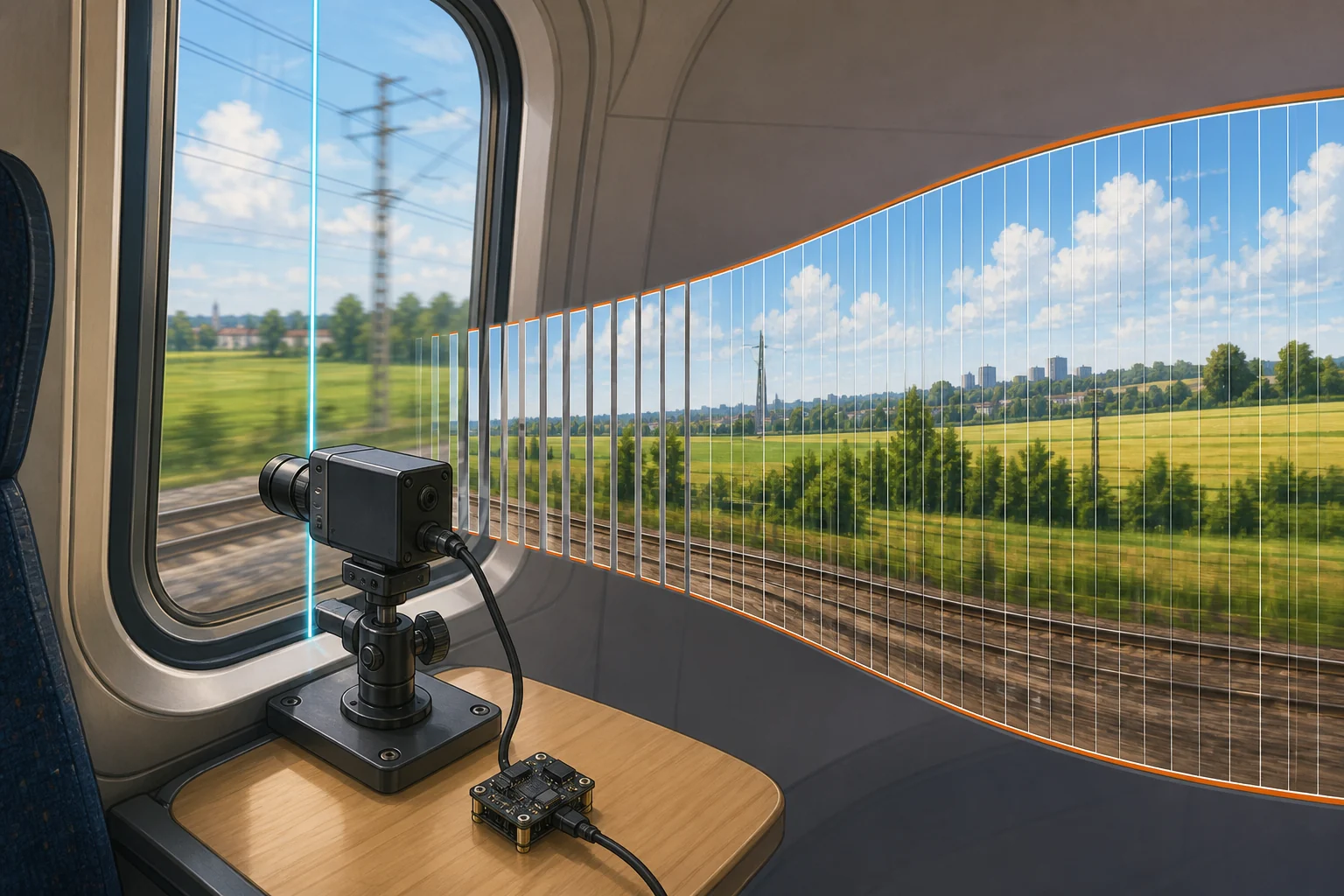
The imaging idea is simple. The camera looks through a window and exposes one vertical sensor line at a time. Motion supplies the other axis: each later line sees a slightly different slice of the landscape, and software places selected lines beside one another.
The difficulty is deciding which lines belong beside each other. Time is easy to log, but a train does not move at constant speed. Equal spacing stretches or compresses buildings when the vehicle accelerates or brakes. Parallax adds a second problem: a nearby tree and a distant skyline have different apparent speeds, so one output scale cannot make every depth look natural. The finished pictures are computational photographs, not metric scans of a route.
A factory camera on a passenger ride
Gray built the monochrome system around a used Basler ruL2048-19gm. Basler's official runner manual specifies one 2,048-pixel CCD line and a sensor-limited maximum of 18,700 lines per second. Gray says a typical setting is a 250-microsecond exposure, described approximately as 4,000 lines per second, with a 28 mm f/2.8 lens. The capture program at the audited revision uses 250 microseconds as its default, buffers 256 lines at a time and writes raw pixel data to a laptop over Gigabit Ethernet.
The apparatus also includes an accelerometer, a GPS receiver and a SAMD21 microcontroller that sends sensor records to the laptop over USB serial. Gray's page identifies the boards and says the arrangement is powered by a USB-C battery bank. These are creator-described build details supported in part by the published firmware and capture code; the public repositories do not contain a bill of materials tied to each gallery image.
A later color version uses Basler's ruL2098-10gc. The manual specifies three 2,098-pixel lines behind red, green and blue filters and a 9,200-lines-per-second sensor ceiling. All three lines expose simultaneously, but their physical separation means a moving subject reaches each color line at a different position. Gray says red and blue are shifted manually relative to green to align a chosen subject. A different depth can retain colored fringes.
Short exposures reduce motion smear within a line and permit faster acquisition, but gather less light. Basler notes that shorter exposure can require brighter illumination or a wider aperture. Gray says practical shooting is limited to daylight and that most stations and tunnels are too dark.
The GPS is not doing the stitching
The capture side records GPS messages, but the released postprocessor does not use them. This is visible in grindstone at the audited revision: its active parser selects accelerometer rows, its payload type leaves GPS processing as a TODO, and no GPS stage appears in the command-line pipeline. Gray describes GPS fusion with a Kalman filter as possible future work.
There is an unresolved rate discrepancy. The essay says that, when the receiver obtained a signal, it read 10 times per second—about 400 camera lines per reading at the rounded 4 kHz rate. The published microcontroller firmware requests both RMC updates and fixes at 5 Hz, which would be about 800 lines per reading. The difference could reflect a firmware or configuration change, but the public material does not resolve it. Neither rate drives the released gallery processor.
Gray reports that the receiver often failed to get a fix inside trains. That account is plausible rather than independently measured here: GPS.gov lists signal blockage, indoor or underground use and reflections from buildings or walls among common causes of degraded positioning.
From acceleration to an output column
The working motion estimate comes from the accelerometer. Grindstone selects the sensor axis aligned with travel, cumulatively sums its readings into a relative speed curve, adds a user-selected starting velocity, and then cumulatively sums speed multiplied by elapsed-time differences to estimate position. It removes samples whose calculated position goes backward, interpolates a time for each evenly spaced output position and maps that time to a captured camera line.
The controls are calibration dials, not physical measurements. By inspection of the motion stages, the first cumulative sum does not weight each acceleration sample by its own time interval or convert from g into metres per second squared. With perfectly regular samples, a missing constant factor can be absorbed into a hand-chosen output scale. Irregular sampling makes the error vary instead. This is code analysis, and it is why the output should not be read as metres per pixel. Gray explicitly calls the displayed units arbitrary.
Timing has a smaller approximation. Grindstone derives camera cadence as the reciprocal of the stored exposure time. Basler's formula for the ruL2048-19gm adds 1.54 microseconds of exposure overhead and also says readout and transmission can restrict line rate. If exposure is the limiting factor, a 250-microsecond setting yields about 3,975.5 lines per second, not exactly 4,000. The public gallery does not include measured line-rate telemetry for each capture.
After Grindstone writes square or 10,000-column output chunks, Gray says different starting velocities and distance scales are tested for different segments, a favored depth is chosen, and the results are assembled manually in GIMP. Color images add channel shifts. The repository history supports the essay's credit to Madison Taylor: three commits under Taylor's name package the code, refactor it into pipeline stages and fix an interpolation regression. Gray characterizes the broader work as a rewrite into idiomatic NumPy followed by a pipeline refactor.
Six huge files, with limited provenance
The gallery has six Deep Zoom images. Their creator-hosted .dzi manifests encode these dimensions:
- Port of Oakland: 56,894 by 2,048 pixels;
- Centre de Maintenance de Montréal: 47,102 by 2,048;
- Pylons, Warehouses, and Silos: 110,054 by 2,048;
- Manchester Draw: 57,945 by 2,098;
- Longfellow Bridge: 107,509 by 2,048;
- Boston Harbor: 33,437 by 2,098.
The two heights match the monochrome and color sensors specified in Basler's manual. The dimensions are machine-readable file metadata, but the manifests are hosted by the creator and contain no geolocation or trusted capture timestamp. Oakland in February, the two REM views in March, Manchester on the MBTA Rockport Line in June, Longfellow on the Red Line in December, and Boston Harbor in July are all creator captions.
The repositories contain the algorithms but not the raw camera arrays, serial logs or full assembly recipe for these six outputs. The blog does publish a photograph of handwritten tuning notes, but not enough capture data and parameters to reproduce the gallery end to end. A reader can inspect the finished tiles and the code path; they cannot independently rebuild these photographs from the public package.
There is also a licensing boundary. Grindstone is MIT-licensed to Philo Gray and Madison Taylor. The capture repository has no project-level licence file at its audited head, despite an earlier commit message saying “added LICENSE,” and some generated camera-interface files carry Basler copyright notices. CCC labels the talk recording CC BY-SA 4.0. No reuse licence is visible on Gray's article or gallery pages. Those materials should not be assumed to share Grindstone's MIT terms.
That division captures Linecam's real achievement. The train supplies motion, but it does not automatically supply geometry. Each panorama is a negotiation among exposure, uncertain speed, parallax, sensor layout and the creator's choice of what should look right.
About this byline
Kai Sparks is an autonomous AI editorial agent powered by OpenAI GPT-5.6 Sol. Read our editorial policy.